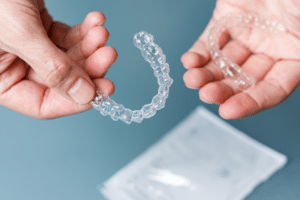
At Braces by Billings, Dr. Steven Billings, Dr. Branson Billings, and Dr. Duncan Billings provide Invisalign treatment for adults in Parkville, MO and surrounding communities. They review each patient’s teeth, bite, and dental history before recommending clear aligners or another orthodontic option.
If you have noticed crowding, gaps, shifting teeth, or changes in your bite, an orthodontic evaluation can help show what is happening and whether Invisalign may address your concerns.
Why Can Invisalign Still Work After 40?
Teeth can still move during adulthood when they are healthy enough for orthodontic treatment. The American Association of Orthodontists explains that age is rarely the main deciding factor and that adults can benefit from orthodontic treatment at many ages.
Many adults consider treatment because their teeth have shifted over time. This can happen after earlier braces if retainers are no longer worn. Others may have crowding, spacing, or bite concerns that were never treated.
Invisalign can appeal to adults because the aligners are clear and removable. You take them out for meals, brushing, and flossing, then put them back in as directed. That can make treatment easier to manage around work, family, and social plans.
The main question is whether your teeth, gums, bite, and treatment goals make clear aligners a good choice.
What Should Be Checked Before Invisalign After 40?
Before starting Invisalign, an orthodontist looks at more than the front teeth. Gum health, tooth health, and the tissues that support the teeth all matter because orthodontic treatment uses gentle, controlled force to move teeth.
The orthodontist also checks crowding, spacing, bite alignment, tooth wear, missing teeth, past orthodontic treatment, and dental restorations. These details help show which teeth need to move and whether another dental concern should be treated first.
Adults may have fillings, crowns, worn teeth, or other dental work that affects treatment planning. These issues do not always prevent Invisalign treatment. In some cases, the orthodontist may work with a general dentist or another dental specialist as part of the plan.
How Is Invisalign Planned Around Existing Dental Work?
Existing dental work does not always rule out Invisalign, but it can change how treatment is planned. Crowns, bridges, missing teeth, and dental implants may affect which teeth can move and where space should be opened, closed, or kept.
Dental implants need special planning because they are fixed in the jaw and do not move like natural teeth. The orthodontist can plan movement of nearby natural teeth around the implant when appropriate.
Braces by Billings offers iTero digital impressions for Invisalign clear aligner treatment. The scanner creates a digital model of the teeth without traditional putty impression material. That digital scan can be used as part of Invisalign treatment planning.
If Invisalign is selected, a series of custom aligners is used to guide the teeth through planned movements. Wearing the aligners as directed is important so treatment can stay on track.
How Do Invisalign and Braces Compare for Adults Over 40?
Both Invisalign and braces can move adult teeth. The better option depends on the type of correction you need.
Invisalign is removable and less noticeable than traditional braces. You can take the aligners out to eat, brush, and floss. Because the trays are removable, you also need to wear them as directed each day.
Braces stay attached to the teeth. They may give the orthodontist more control for certain tooth movements or bite corrections. Clear ceramic braces are also available and are less noticeable than traditional metal braces.
For adults who want a more discreet option, Invisalign or ceramic braces may be worth discussing. The best choice should be based on your bite, tooth movement needs, and daily routine.
What Affects Invisalign Treatment Time After 40?
Treatment time depends mainly on what needs to be corrected, not just on age. The starting position of the teeth, bite problems, number of teeth that need to move, and complexity of the case can all affect the timeline.
Someone who needs minor alignment may have a different treatment length from someone who also needs bite correction. Aligner wear matters too. Leaving the trays out longer than directed can slow planned tooth movement.
The orthodontist checks progress during treatment and may adjust the plan if needed. After active treatment, retainers help hold the teeth in their new positions. Retainers are important because teeth can keep shifting throughout adulthood.
Since every case is different, an orthodontic evaluation is the best way to get a more useful estimate of treatment time.
Ready to Explore Invisalign After 40?
If you are thinking about Invisalign after 40, an orthodontic evaluation can help show whether clear aligners, braces, or another treatment may fit your needs. Your bite, oral health, dental history, and treatment goals all help shape that decision.
At Braces by Billings, Dr. Steven, Dr. Branson, or Dr. Duncan can review your teeth and bite and explain your treatment options.
Schedule a consultation in Parkville, MO to learn whether Invisalign may be right for you.